

Backgammon within Nothingness
The throw you make also makes you

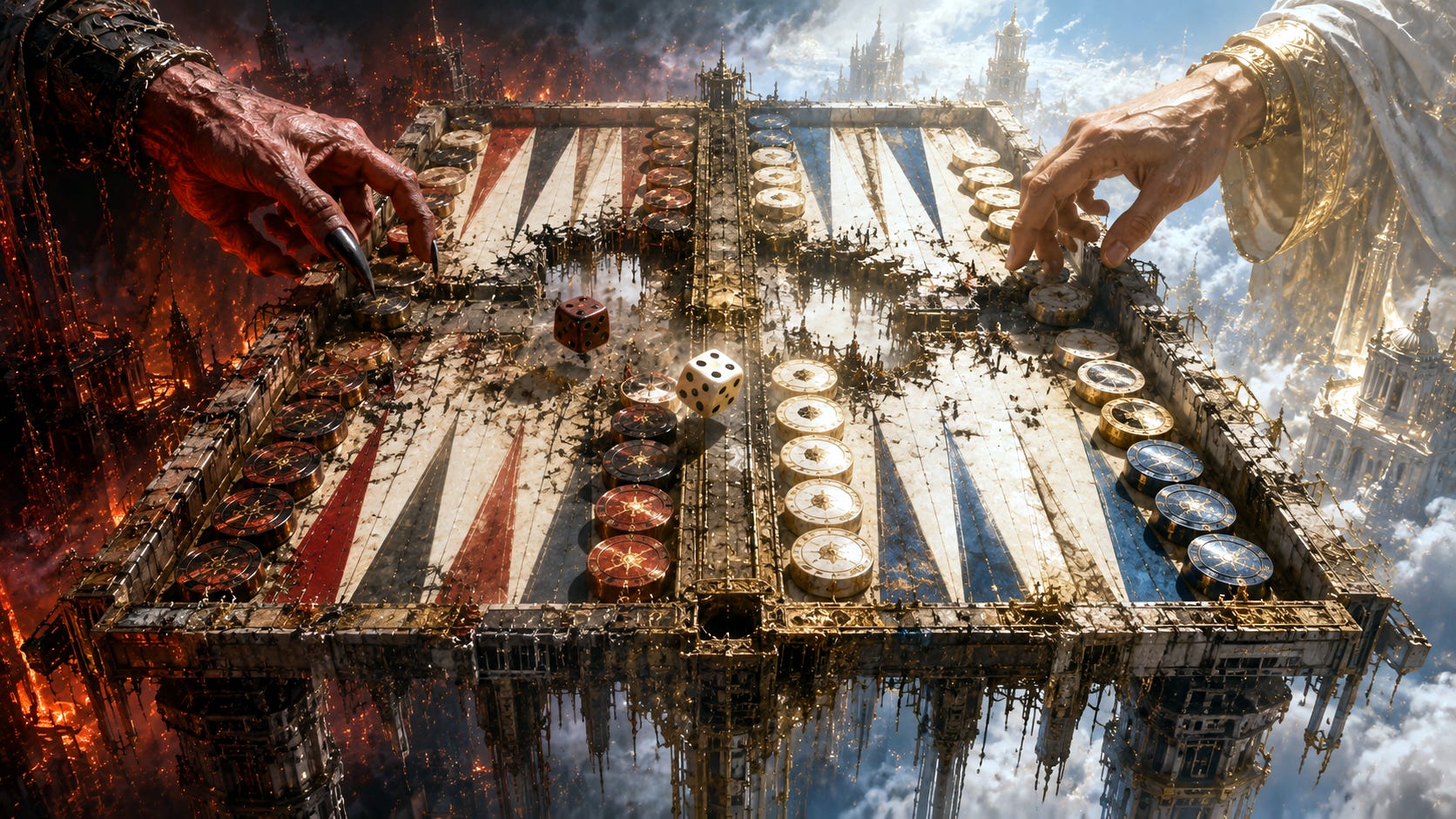
God and the Devil play backgammon in the middle of nothingness, and what you call order is just a position that hasn’t been disturbed yet. Pieces gather into lines that look deliberate, holding long enough to feel stable before loosening again just enough to prevent settling, and the board holds only while their touches overlap; then the next throw rearranges it without apology, not as disruption, but as continuation.
You trust what repeats because it returns wearing the same shape. Matter, energy, and information are only different arrangements surviving across throws; a line forms early and holds across a few throws, not because it cannot be broken but because nothing has yet forced it to break, and you begin to read intention into it; a sequence lands, you remember it, and expectation forms, even though each return comes from fresh throws that owe nothing to the last.
Pieces gather into clusters that absorb pressure for a few turns before gaps open at their edges, and neither gains ground because the board exists only as their alternation. A line closes across the board and holds for two turns, forcing the other side to play around it; then a single throw lands just wrong, one piece slips out of place, the gap opens, and the same line that looked secure becomes the path of its own undoing; the break feels sudden only because the slow thinning was easy to ignore.
You call it progress when God’s lines stretch across the board, but the Devil walks alongside them, cutting paths that undo the stretch just as quietly. A series of favorable throws extends one side, and you name it direction, even though the pattern exists only while the throws sustain it. The board moves without favor.
Nothing holds because neither God nor the Devil can stop the next throw. God keeps pieces together for a while, the Devil wears them down with each move, and the cost of holding becomes visible in a single break; the board does not fail; the position yields as the balance shifts. Staying intact is a brief advantage that reads as meaning.
You look for control and find limits shared by both. The first throw is called the Big Bang only after the pieces are already in motion; time exists only as the sequence of throws. God operates within the rules that allow structure, the Devil within the same rules that allow its undoing, and the dice interrupt both with numbers that force a different play.
A throw lands and leaves you two moves, one that secures a piece but opens a longer line, another that keeps the line but exposes a single piece to be taken; you choose within the move, and the next throw shows the cost of that choice, not as punishment, but as continuation. Skill keeps you in the game, but it only delays how the next throw takes its side.
You keep waiting for a last throw the game never needs.